Bradenton Family Law Attorney
Florida Attorneys
Serving You and The State of Florida
Divorce delays, ignored timesharing schedules, and outdated support orders rarely improve on their own. By the time most people reach out to a Bradenton family law attorney, frustration has been building for weeks or months.
Lopez Law Group represents individuals and parents throughout Bradenton and Manatee County in divorce, timesharing, child support, alimony, paternity, and post-judgment matters. Our team provides direct guidance and realistic expectations from the first conversation forward.
Call (727) 933-0015 to discuss your situation and current rates. Consultations for family law matters are paid.
Table of Contents
- Why Choose Lopez Law Group for Family Law in Bradenton
- Divorce in Bradenton: What Florida Law Requires
- How Does Child Custody Work in Florida?
- Child Support in Florida
- How Does Florida Divide Marital Property?
- Alimony in Bradenton Divorce Cases
- Do I Need a Family Law Attorney for a Divorce in Bradenton?
- FAQs for Bradenton Family Law Attorneys
Why Choose Lopez Law Group for Family Law in Bradenton

Family law cases involve some of the most consequential decisions a person faces, and they unfold under pressure, on tight timelines, and often while managing children, shared finances, and a household in transition. Our Bradenton family law attorneys handle these cases with the procedural accuracy Florida family law demands and the direct communication that people under pressure actually need.
Manatee County’s circuit court follows its own local procedures, filing requirements, and judicial expectations. Understanding how a case moves through that system matters as much as knowing the applicable statutes. Our team works with clients from the first consultation through final orders and, when circumstances change, through modifications and enforcement proceedings.
How Lopez Law Group family law attorneys in Bradenton can help:
- Divorce, including contested and uncontested proceedings
- Timesharing and parenting plan disputes
- Child support establishment, modification, and enforcement
- Alimony and spousal support
- Equitable distribution of marital assets and debts
- Paternity establishment and related custody matters
- Post-judgment modifications to existing orders
- Enforcement and contempt proceedings
- Domestic violence injunctions
- Adoption
Each of these matters carries its own procedural requirements and timeline. The sections below address what most Bradenton families encounter when navigating Florida’s family law system.
Divorce in Bradenton: What Florida Law Requires
Florida is a no-fault divorce state, meaning neither party needs to prove wrongdoing to obtain a dissolution of marriage. The only required ground is that the marriage is irretrievably broken. That standard is straightforward, but everything that follows depends on whether the parties agree on the issues involved.
Uncontested Divorce
An uncontested divorce occurs when both parties reach an agreement on all issues, including property division, parenting arrangements, and support, before filing or shortly after. These proceedings generally move faster and cost less than contested ones. The agreement is memorialized in a marital settlement agreement and parenting plan, which the court reviews and incorporates into the final judgment. Learn more about how to file for divorce in Florida and what each step involves.
Contested Divorce
When parties cannot reach an agreement, the court resolves disputed issues after receiving evidence and argument from both sides. Contested divorces involve additional procedural steps, including mandatory financial disclosure, mediation, and potentially a final hearing or trial. The timeline for contested proceedings in Manatee County depends on the complexity of the issues and the court’s availability.
How Does Child Custody Work in Florida?
Florida does not use the term “custody” in the traditional sense. Instead, the law establishes timesharing arrangements and requires all parents to have a court-approved parenting plan. This applies to divorcing parents and to unmarried parents establishing paternity and parental rights.
What Does a Florida Parenting Plan Need to Include?
In Bradenton family law cases, a parenting plan must address:
- The daily tasks associated with raising the child
- The timesharing schedule designating where the child will be on specific days
- Decision-making authority for school and healthcare matters
- Communication methods between the child and each parent
Plans that fall short of these requirements may not be approved by the court, sending parents back to the negotiation table.
How Florida Courts Determine Timesharing
Florida courts evaluate timesharing based on the best interests of the child under the factors listed in Florida Statutes § 61.13. Those factors include each parent’s willingness to support the child’s relationship with the other parent, the child’s established routine and community ties, each parent’s demonstrated capacity to meet the child’s needs, and the geographic practicality of the proposed arrangement, among others.
Florida law does not presume that equal timesharing is always appropriate, but it does reflect a general policy favoring frequent contact with both parents when that arrangement serves the child’s interests.
Timesharing Modifications
Modifying an existing timesharing arrangement requires demonstrating a substantial, material, and unanticipated change in circumstances since the entry of the last order. The modification must also serve the child’s best interests.
Common circumstances that support modification include a parent’s relocation, a significant change in a child’s needs, or documented concerns about the child’s welfare under the current arrangement.
Child Support in Florida
Florida calculates child support using an income shares model established in Florida Statutes § 61.30. The formula considers both parents’ net incomes, the number of overnights each parent has with the child, health insurance costs, and childcare expenses. The resulting guideline amount is presumptively correct, though courts may deviate from it under specific circumstances.
What Counts as Income for Child Support Purposes
Florida’s child support statute defines income broadly. It includes wages, salary, bonuses, commissions, self-employment income, rental income, and, in some circumstances, imputed income when a parent is voluntarily unemployed or underemployed.
Accurately documenting income, particularly for self-employed parents or those with variable compensation, has a direct impact on the support calculation.
Modifying Child Support
Child support may be modified when a substantial change in circumstances has occurred, which Florida law defines as a change of at least 15 percent or $50 in the monthly obligation, whichever is greater.
Common triggers include a significant shift in either parent’s income, a change in the timesharing arrangement, or a change in the child’s healthcare or childcare costs.
How Does Florida Divide Marital Property?
Florida divides marital property under the principle of equitable distribution, meaning fair but not necessarily equal. Marital assets and liabilities are those acquired during the marriage, regardless of whose name appears on them. Separate property, meaning assets owned before the marriage or received as gifts or inheritance during the marriage, is generally not subject to division.
What Equitable Distribution Actually Involves
Equitable distribution requires identifying all marital assets and liabilities, establishing their values, and proposing a division that the court considers fair under the circumstances.
Assets commonly subject to division include:
- The marital home and any other real property
- Retirement accounts and pensions
- Investment and bank accounts
- Business interests
- Vehicles and personal property
- Marital debt, including mortgages, credit cards, and loans
Retirement accounts deserve particular attention. Dividing a 401(k) or pension often requires a qualified domestic relations order (QDRO), a separate court order that tells the plan administrator how to divide the account. Taxes and penalties depend on the type of plan and how any funds are later withdrawn. Handling this incorrectly creates tax liability and enforcement problems that are difficult to unwind after the divorce is final.
Alimony in Bradenton Divorce Cases

Alimony is one of the most contested issues in Florida divorce proceedings. Florida law recognizes several forms of alimony, each designed for different circumstances. The type and amount a court awards depends on one spouse’s demonstrated need and the other’s ability to pay, along with factors such as the length of the marriage, the standard of living during the marriage, each spouse’s earning capacity, and contributions to the other’s career or education.
Types of Alimony Under Florida Law
Florida recognizes four forms of alimony, and each serves a distinct purpose:
- Bridge-the-gap alimony assists a spouse in transitioning from married to single life. It covers short-term, identifiable needs and is limited to two years. This form of alimony is not modifiable in either amount or duration once awarded.
- Rehabilitative alimony supports a spouse in acquiring the education, training, or work experience needed to become self-supporting. It requires a specific, defined rehabilitative plan submitted to the court.
- Durational alimony provides financial support for a set period following the divorce. The length of the award may not exceed the length of the marriage, and the amount is subject to modification if circumstances change substantially.
- Permanent alimony is reserved for limited situations, typically involving long-term marriages where one spouse lacks the ability to meet their needs even after the other forms of alimony have been considered. The 2023 statutory revisions significantly narrowed when permanent alimony may be awarded.
How Marriage Length Affects Alimony
Florida law classifies marriages into three categories that influence alimony decisions:
- A short-term marriage is one lasting fewer than 10 years.
- A moderate-term marriage falls between 10 and 20 years.
- A long-term marriage exceeds 20 years.
Courts are more likely to award longer or more substantial alimony in moderate-term and long-term marriages, though every case is evaluated on its own facts.
Florida’s 2023 Alimony Reform
Florida’s alimony statute underwent significant revisions in 2023 under Senate Bill 1416. The changes reshaped how courts approach alimony in several important ways.
Durational alimony is now subject to specific percentage caps tied to the length of the marriage. The revised statute also limits the circumstances in which permanent alimony may be awarded, requiring the court to find that no other form of alimony is sufficient to meet the requesting spouse’s needs. Additionally, the law introduced new provisions allowing a paying spouse to seek modification or termination of alimony based on retirement, provided the retirement age and circumstances meet the statutory requirements.
These revisions apply to cases filed after July 1, 2023. For cases filed before that date, the prior statutory framework may still govern. Because the interaction between the old and new statutes creates complexity, alimony cases in Bradenton benefit from careful legal analysis tailored to the specific timeline and facts of the marriage.
Do I Need a Family Law Attorney for a Divorce in Bradenton?
Florida allows individuals to represent themselves in divorce proceedings, and some uncontested divorces with no minor children and minimal shared assets move forward that way without major complications. Most divorces, however, turn out to be more involved than they first appear.
The Stakes Might Be Higher Than the Paperwork Suggests
A divorce decree is a permanent court order, and some of its terms are difficult or impossible to change after the fact. Property division, for example, is generally not modifiable once the judgment is entered. Parenting plans and support orders allow for modification, but only by meeting a legal standard and returning to court. Getting the initial order right almost always costs less than correcting it later.
What to Bring to a First Consultation
Coming prepared makes the first meeting more productive and helps our attorneys identify the issues that matter most in your case. Useful documents include:
- Recent tax returns and pay stubs
- Mortgage statements and property records
- Retirement and investment account statements
- A list of significant marital assets and debts
- Any existing court orders related to prior proceedings
- For custody matters, a general outline of the current parenting arrangement and any documentation of relevant incidents
Even if some of these documents are not readily available, bringing what you have gives our team a starting point for evaluating your situation and outlining next steps.
FAQs for Bradenton Family Law Attorneys
What If My Ex Won’t Follow the Court Order?
Document every violation with dates, times, and specifics, then contact a family law attorney promptly.
Remedies depend on the type of violation:
- For unpaid child support, the court may order income withholding, suspend the non-paying parent’s driver’s license, or impose jail time until the obligation is met
- For timesharing violations, the court may award makeup parenting time, modify the existing schedule, or hold the violating parent in contempt
- For property division violations, the court may impose financial sanctions or enter additional orders to force compliance
Courts take violations of timesharing and support orders seriously, and consistent documentation strengthens an enforcement case significantly.
Can Grandparents Get Visitation in Florida?
Florida’s grandparent visitation statute is narrow. Courts may award visitation only in limited circumstances, such as when a parent is deceased, missing, or in a persistent vegetative state (and other specific legal requirements are met). Being born out of wedlock, by itself, does not automatically give grandparents visitation rights in Florida. Florida courts give significant weight to parental decision-making rights, making grandparent visitation cases fact-specific and procedurally complex.
What Is the Difference Between Parental Responsibility and Timesharing in Florida?
Parental responsibility refers to decision-making authority over major issues like education, healthcare, and religious upbringing. Timesharing refers to the schedule governing where the child resides. Both are addressed in the parenting plan. Courts may award shared parental responsibility while approving an unequal timesharing schedule, or vice versa, depending on the circumstances.
Do I Need a Lawyer for a Modification If We Both Agree?
Even when both parties agree on a modification, the change must be formalized through a court order to be enforceable. An informal agreement between parents is not legally binding and offers no protection if circumstances shift again. A family law attorney prepares the necessary documents, files them correctly, and obtains the court order that makes the agreement official.
What Happens to the House in a Florida Divorce?
The marital home is a marital asset subject to equitable distribution. Common outcomes include one spouse buying out the other’s interest and refinancing the mortgage, selling the home and dividing the proceeds, or, in cases involving minor children, a deferred sale arrangement that allows the children to remain in the home until a specified event, such as the youngest child finishing school.
Does Signing the Birth Certificate Establish Legal Paternity in Florida?
Not always. In Florida, an unmarried father may establish legal paternity by signing a voluntary acknowledgment of paternity or through a court case. A court order is typically needed to set enforceable timesharing and child support.
What Legal Rights Does a Paternity Order Create in Florida?
A court order establishing paternity allows the father to pursue a parenting plan and timesharing schedule, establishes the child’s right to support from both parents, and creates eligibility for inheritance rights and access to family medical history.
When the Decisions Can’t Wait, Call Lopez Law Group
Some family law situations demand immediate attention. A parent who violates a timesharing order, a spouse who begins transferring assets, or a situation involving domestic violence creates urgency that general research cannot address.
Our family law attorneys serve individuals and parents throughout Bradenton and Manatee County, ready to assess your situation, outline your options, and help you move forward with a clear picture of what Florida law actually allows. Reach the Bradenton office or contact us online to discuss your situation, current rates, and next steps.
Lopez Law Group
1215 Manatee Ave W #109
Bradenton, FL 34205
Phone: (941) 401-1351
Email: info@thelopezlawgroup.com
Hours: Monday – Friday: 9:00 AM – 5:00 PM
Practice Areas
- Business Lawyers
- Residential Real Estate Lawyers
- Commercial Real Estate Lawyers
- DUI Lawyers in Florida
- Expunction and Sealing Lawyers
- Florida Clemency
- Injunction Lawyers
- Tenant Lawyers
- Landlord Lawyers
- HOA Lawyers
- Defamation Lawyers
- Eviction Attorneys
- Moving Company Dispute Lawyers
- Probate Lawyers in Florida
What Our Clients Say

A Godsend
Mr. Lopez was a Godsend and really helped me with my situation. Him and the entire firm were very diligent and helped speed the early stages of the process along due to a pressing situation. Throughout my experience working with the firm, they were always responsive and available any time I had a question or wanted to check on the state of affairs. Hopefully I won’t have to recommend Lopez Law Group to my friends or family, but if those unfortunate circumstances arise then there’s only one name I would trust. Thank you again for all your help!
Lopez Law Group Can See You Through Cases Like:




Don't See What You Need?
AS SEEN ON:





Lopez Law Group
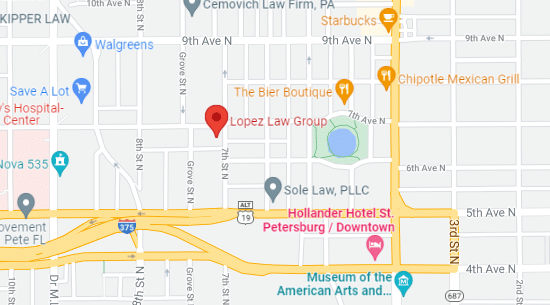
700 7th Ave N, Suite A,
St. Petersburg, FL 33701
P: 727-933-0015
Business Hours
Mo, Tu, We, Th, Fr
Schedule a Call Back
Book a Consultation