
Bradenton Injunction Attorney
Florida Attorneys
Serving You and The State of Florida
An injunction filed in Manatee County circuit court can restrict where a person lives, who they contact, and whether they may possess firearms, sometimes within hours of the petition being filed.
At Lopez Law Group, our Bradenton injunction attorneys represent people on both sides of these proceedings: those seeking court-ordered protection from violence or stalking, and those who have been served with an injunction and need to prepare a defense before the hearing date arrives.
Lopez Law Group handles injunction cases throughout Bradenton and Manatee County, including petitions for protection and defense against injunctions involving domestic violence, dating violence, repeat violence, sexual violence, stalking, and cyberstalking. Our attorneys prepare evidence, advise on what the court needs to see, and represent clients at temporary and final injunction hearings in the 12th Judicial Circuit. Call (727) 933-0015 to discuss your situation.
Table of Contents
- Why Choose Lopez Law Group as Your Injunction Attorney in Bradenton
- Types of Injunctions in Florida
- How Does the Injunction Process Work in Manatee County?
- Defending Against an Injunction in Bradenton
- What Can a Bradenton Injunction Restrict?
- What Evidence Matters Most in an Injunction Case?
- Modifying or Dissolving an Injunction
- FAQs for Bradenton Injunction Attorneys
Why Choose Lopez Law Group as Your Injunction Attorney in Bradenton

Florida’s injunction process moves fast. A judge may issue a temporary injunction the same day a petition is filed, often without hearing from the other side. That temporary order is usually set for a hearing within about 15 days, and it can remain in place until the court holds the hearing or enters a new order.
For petitioners, the petition itself carries significant weight. A vague or poorly supported filing may result in the judge declining to issue a temporary order. For respondents, the return hearing may be the only opportunity to challenge the claims before a final injunction enters, one that could remain in effect indefinitely.
In either position, preparation determines the outcome. Text messages, call logs, photos, witness statements, and police reports all matter. Knowing what evidence the court considers persuasive, and how to present it under the rules of the 12th Judicial Circuit, is where legal representation makes a measurable difference.
What Our Lawyers Can Help With
Lopez Law Group represents clients on both sides of injunction proceedings in Manatee County. That includes filing petitions for individuals seeking court-ordered protection and defending those who have been served with an injunction and face a hearing they did not initiate.
Beyond the initial filing or response, injunction cases often involve additional proceedings:
- Emergency petitions when immediate protection is needed and delays create safety concerns
- Motions to modify, extend, or dissolve existing injunctions as circumstances change
- Contempt and enforcement actions when an injunction has been violated
Each of these matters follows its own procedural path in the 12th Judicial Circuit, and the timeline for most of them is measured in days rather than weeks.
Types of Injunctions in Florida
Florida law recognizes several categories of injunctions for protection, each governed by its own statute and evidentiary requirements. The type of injunction available depends on the relationship between the parties and the nature of the conduct involved.
Domestic Violence Injunctions
Under Florida Statutes § 741.30, a person may petition for a domestic violence injunction if they are the victim of domestic violence or have reasonable cause to believe violence is imminent. The petitioner and respondent must have a qualifying relationship: current or former spouses, relatives by blood or marriage, people who have lived together as a family, or people who share a child.
Domestic violence injunctions are among the most commonly filed in Manatee County. A final order may require the respondent to vacate a shared residence, surrender firearms, and comply with temporary custody and support provisions.
Dating Violence Injunctions
Dating violence injunctions apply when the parties have had a dating relationship within the past six months — meaning a continuing and significant relationship with frequent interaction, not casual socializing.
Like domestic violence cases, the petitioner must demonstrate that violence occurred or that future violence is reasonably expected.
Repeat Violence Injunctions
Under Florida Statutes § 784.046, repeat violence injunctions require evidence of at least two incidents of violence or stalking, with one occurring within six months of filing. No special relationship between the parties is required. These cases commonly involve neighbors, coworkers, or acquaintances in escalating disputes.
Sexual Violence Injunctions
Sexual violence injunctions are available regardless of the relationship between the parties. The petitioner must demonstrate that they were the victim of sexual battery, a lewd act, or other qualifying sexual conduct. In many cases, the incident must have been reported to law enforcement or involve a qualifying criminal or court process, and the court will closely examine the evidence supporting the petition.
Stalking and Cyberstalking Injunctions
Under Florida Statutes § 784.0485, a person who is the victim of stalking or cyberstalking may petition for an injunction for protection. Stalking under Florida law involves willfully, maliciously, and repeatedly following or harassing another person. Cyberstalking involves similar conduct carried out through electronic communication. Any person may file this type of petition; a domestic or dating relationship is not required.
How Does the Injunction Process Work in Manatee County?
Injunction petitions in Bradenton are filed through the Manatee County Clerk of Circuit Court’s Violence Protection Division, located at the Erin Craft Center, 1115 Manatee Avenue West. There is no filing fee for any type of injunction petition in Florida.
Filing the Petition
The petitioner completes a sworn petition describing the specific facts and incidents that form the basis for requesting protection. The clerk’s office provides the forms and assists with completion. Once filed, a judge reviews the petition, typically the same day.
Temporary Injunction
If the judge finds sufficient grounds, a temporary injunction is issued ex parte, meaning without the respondent present. This order takes effect immediately upon service and typically lasts 15 days. A return hearing is set within that window. If the judge does not issue a temporary order, a hearing on the petition is still scheduled.
Service on the Respondent
The Manatee County Sheriff’s Office serves the respondent with copies of the petition, the temporary injunction (if granted), and notice of the hearing. The injunction is not enforceable until the respondent has been served.
The Return Hearing
The return hearing is where both sides present their case. Each party may offer testimony, call witnesses, and introduce evidence such as text messages, photographs, medical records, and police reports. The judge evaluates the evidence and decides whether to enter a final injunction, deny the petition, or modify the terms.
Final injunctions under Florida law do not have an automatic expiration date for most categories. They remain in effect until the court modifies or dissolves them.
Defending Against an Injunction in Bradenton
Being served with an injunction petition is serious. A final injunction creates a permanent court record, may restrict contact with family members, and carries consequences that extend into employment, housing, and firearms ownership.
Why the Hearing Matters More Than Most People Realize
Many respondents assume that simply telling their side of the story at the hearing will be enough. Florida injunction hearings follow evidentiary rules, and judges evaluate credibility, documentation, and the specific statutory requirements for each injunction type.
Arriving without organized evidence, prepared testimony, or an understanding of what the court considers puts the respondent at a significant disadvantage.
Common Defense Strategies
The appropriate defense depends entirely on the facts and the type of injunction involved.
Common approaches include:
- Demonstrating that the alleged conduct does not meet the statutory definition
- Presenting contradictory evidence such as text messages, surveillance footage, or witness testimony
- Showing that the petition was filed as leverage in a custody or divorce dispute rather than based on genuine safety concerns
- Challenging the credibility of the petitioner’s account through cross-examination and documentation
Our injunction defense lawyers evaluate the petition, assess the available evidence, and prepare a defense strategy tailored to the hearing. In some cases, negotiating agreed-upon terms that both parties find acceptable may resolve the matter without a contested hearing.
What Can a Bradenton Injunction Restrict?
The scope of a final injunction depends on the type and the court’s findings. Restrictions commonly imposed include:
- No contact provisions prohibiting direct, indirect, or third-party communication with the petitioner
- Stay-away orders requiring the respondent to remain a specified distance from the petitioner’s residence, workplace, school, or other locations
- Residence exclusion ordering the respondent to vacate a shared home
- Temporary custody and support provisions in cases involving minor children
- Firearms surrender requiring the respondent to turn over all firearms and ammunition to law enforcement or a licensed dealer
Understanding the exact terms of the order is critical, because even unintentional contact or a misreading of the geographic restrictions may constitute a violation with criminal consequences.
How Does an Injunction Affect Firearms Rights?
A final injunction can restrict firearm and ammunition possession under Florida Statutes § 790.233 and 18 U.S.C. § 922(g)(8), depending on the type of injunction and the order’s terms. Violating a firearms restriction or a surrender requirement can lead to criminal charges.
What Evidence Matters Most in an Injunction Case?

Injunction hearings in Manatee County are decided based strongly on the evidence each side presents. The judge is evaluating whether the statutory standard has been met, and credible, organized evidence is the strongest tool available to either party.
Evidence that frequently affects the outcome includes:
- Text messages, voicemails, emails, and social media communications showing threats, harassment, or patterns of contact
- Photographs of injuries, property damage, or the respondent’s presence at prohibited locations
- Police reports, incident reports, and arrest records
- Medical records documenting injuries consistent with the alleged violence
- Witness testimony from people with firsthand knowledge of the events
- Phone records, GPS data, and security camera footage establishing timelines
Organizing this evidence before the hearing and understanding how to present it within the court’s procedural rules is where attorney involvement has the most direct impact on the outcome.
Modifying or Dissolving an Injunction
Florida law allows either party to petition the court to modify or dissolve an existing injunction at any time. Modification may involve adjusting no-contact provisions, changing custody terms, or narrowing the geographic restrictions. Dissolution ends the injunction entirely.
The court evaluates whether circumstances have changed sufficiently to warrant modification or dissolution, and the moving party carries the burden of demonstrating why the change is appropriate.
In domestic violence cases, courts are particularly cautious and evaluate the petitioner’s current safety concerns before modifying protective terms.
FAQs for Bradenton Injunction Attorneys
How Quickly Can a Judge Issue a Temporary Injunction in Manatee County?
A judge typically reviews the petition the same day it is filed with the Manatee County Clerk’s Violence Protection Division. If the judge finds the petition meets the statutory requirements, a temporary injunction may be issued that day. The order takes effect once the respondent is served.
Can I Fight an Injunction Based on Exaggerated or False Claims?
The return hearing is the opportunity to challenge the petition’s factual basis. Presenting contradictory evidence, calling the petitioner’s credibility into question through cross-examination, and demonstrating that the alleged conduct does not meet the statutory threshold are all available strategies. An attorney evaluates the specific claims and prepares a defense focused on the weaknesses in the petition.
What Happens If Someone Violates an Injunction in Florida?
Violating an active injunction can lead to arrest and criminal charges, and the court may also enforce the order through contempt proceedings. For domestic violence and stalking injunctions, a violation is a first-degree misdemeanor carrying up to one year in jail. Violations involving firearm possession carry separate penalties under both state and federal law.
Can an Injunction Affect Custody or Timesharing in a Divorce?
An active injunction may significantly affect family law proceedings. Courts consider injunctions when evaluating parenting plans and timesharing arrangements. A domestic violence injunction may result in restricted or supervised timesharing for the respondent. If a family law case is pending, the courts may adjust orders to avoid conflicts, but you must follow the terms of any injunction unless and until a judge changes it.
Does an Injunction Show Up on a Background Check in Florida?
Injunctions are civil court orders, not criminal convictions, but they are entered into the Florida Crime Information Center (FCIC) and the National Crime Information Center (NCIC) databases. Employers, landlords, and licensing agencies conducting background checks may discover an active injunction. A final injunction may also affect professional licenses, security clearances, and immigration proceedings, depending on the type and terms of the order.
Talk to a Bradenton Injunction Lawyer Before the Hearing
Filing or responding to an injunction in Manatee County involves statutory requirements, evidentiary standards, and hearing procedures that move on a compressed timeline. Having an attorney involved early gives both petitioners and respondents the strongest position when the hearing date arrives.
Lopez Law Group represents clients on both sides of injunction proceedings in the 12th Judicial Circuit. Reach the Bradenton office or contact us online to discuss your situation and next steps.
Lopez Law Group
1215 Manatee Ave W #109
Bradenton, FL 34205
Phone: (941) 401-1351
Hours: Monday – Friday: 9:00 AM – 5:00 PM
Practice Areas
- Business Lawyers
- Residential Real Estate Lawyers
- Commercial Real Estate Lawyers
- DUI Lawyers in Florida
- Expunction and Sealing Lawyers
- Florida Clemency
- Injunction Lawyers
- Tenant Lawyers
- Landlord Lawyers
- HOA Lawyers
- Defamation Lawyers
- Eviction Attorneys
- Moving Company Dispute Lawyers
- Probate Lawyers in Florida
What Our Clients Say

A Godsend
Mr. Lopez was a Godsend and really helped me with my situation. Him and the entire firm were very diligent and helped speed the early stages of the process along due to a pressing situation. Throughout my experience working with the firm, they were always responsive and available any time I had a question or wanted to check on the state of affairs. Hopefully I won’t have to recommend Lopez Law Group to my friends or family, but if those unfortunate circumstances arise then there’s only one name I would trust. Thank you again for all your help!
Lopez Law Group Can See You Through Cases Like:




Don't See What You Need?
AS SEEN ON:





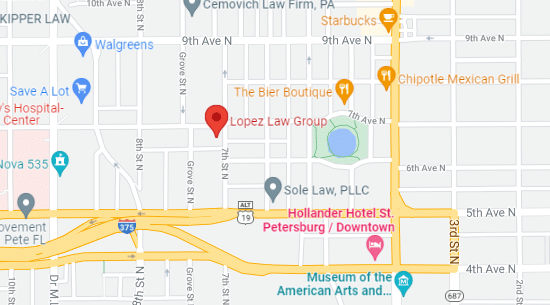
Lopez Law Group
700 7th Ave N, Suite A,
St. Petersburg, FL 33701
P: 727-933-0015
Business Hours
Mo, Tu, We, Th, Fr
Schedule a Call Back
Book a Consultation