Bradenton Insurance Claim Lawyer
Florida Attorneys
Serving You and The State of Florida
A Bradenton insurance claims attorney steps in when the insurer that collected premiums for years suddenly delays payment, offers far less than the damage warrants, or denies coverage entirely.
An insurance policy is a contract, and a broken one creates legal options. Our attorneys review the policy language, evaluate the insurer’s handling of the claim, and pursue the payment the policy was written to provide.
If your insurance claim was denied, delayed, or underpaid in Bradenton, you may have legal options under Florida law. Insurance companies must follow strict statutory procedures when evaluating claims, and failure to do so may give policyholders the right to pursue payment, interest, attorney’s fees, and in some cases, bad faith damages.
Lopez Law Group represents policyholders in Bradenton and Manatee County in insurance claim disputes involving denied claims, underpayments, unreasonable delays, and bad faith conduct by insurers. Our insurance claim attorneys handle disputes from initial claim review through litigation when the insurer refuses to honor its obligations. Call (727) 933-0015 to discuss your situation and current rates. Consultations for insurance claim matters are paid.
Table of Contents
- Why Trust Our Bradenton Lawyers With Your Insurance Claim Disputes
- How Insurance Claim Disputes Arise in Florida
- What Is Insurance Bad Faith in Florida?
- What Are Common Types of Insurance Claim Disputes in Florida?
- What Documentation Strengthens an Insurance Claim Dispute?
- FAQs for Bradenton Insurance Claims Attorneys
Why Trust Our Bradenton Lawyers With Your Insurance Claim Disputes
Insurance companies employ adjusters, engineers, and legal teams whose job is to evaluate claims for the insurer’s financial interest. Policyholders dealing with property damage, financial loss, or a coverage denial are negotiating against that infrastructure with their own money on the line.
An insurance claims attorney balances out this dynamic. Our role is to interpret the policy, identify where the insurer’s position conflicts with the coverage the policyholder purchased, and apply pressure through the channels Florida law provides, from formal demand letters and presuit notices to litigation in Manatee County circuit court.
How Our Insurance Claims Lawyers Help Bradenton Policyholders
The scope of an insurance dispute depends on the type of claim and the insurer’s conduct. Our attorneys assist with:
- Reviewing the insurance policy to identify applicable coverage, exclusions, and conditions
- Evaluating denial letters and determining whether the stated basis for denial is supported by the policy language
- Challenging underpayments where the insurer’s estimate falls significantly below the actual cost of repairs or losses
- Preparing and filing presuit notices required under Florida law before litigation may proceed
- Negotiating with adjusters and insurer counsel to resolve claims without litigation when possible
- Filing suit in Manatee County circuit court when the insurer refuses to pay what the policy requires
Florida’s insurance litigation framework includes specific procedural steps that must be followed before a policyholder may file suit. Missing a required notice or filing deadline may limit available remedies. Attorney involvement early in the dispute protects both the claim and the policyholder’s legal options.
How Insurance Claim Disputes Arise in Florida
Most insurance disputes follow a pattern. The policyholder files a claim, the insurer investigates, and the insurer’s response falls short of what the policy covers. The specific form that takes varies, but the underlying disputes tend to fall into a few categories.
Denied Claims
A denial means the insurer has determined that the claim is not covered under the policy. Some denials are based on legitimate exclusions or policy conditions the policyholder did not meet. Others might rely on strained interpretations of policy language, incomplete investigations, or facts the insurer failed to verify.
Common denial reasons that warrant legal review include exclusions the insurer applies broadly when the policy language is narrower, claims denied for late notice when the policyholder reported within a reasonable timeframe, denials based on the insurer’s own inspection that contradicts independent assessments, and coverage determinations that ignore or mischaracterize the cause of loss.
Underpaid Claims
An underpayment occurs when the insurer accepts coverage but offers significantly less than the actual cost to repair or replace the damaged property. This is among the most common disputes in Florida property insurance claims.
Underpayments often result from the insurer’s adjuster underscoping the damage, using repair estimates that do not reflect current material and labor costs, or excluding items that are clearly within the scope of the covered loss. The gap between what the insurer offers and what repairs actually cost leaves the policyholder absorbing a loss the policy was designed to cover.
Delayed Claims
Florida law requires insurers to handle claims promptly, but “promptly” is not always what policyholders experience. Repeated requests for documentation already provided, long gaps between communications, reassignment of adjusters mid-claim, and extended investigation periods without a coverage determination are all common delay tactics.
Delays are not just inconvenient. For a homeowner with an active roof leak or a business owner unable to operate, every week without a coverage determination or payment creates additional financial damage.
Coverage Disputes
Coverage disputes arise when the insurer and the policyholder disagree about what the policy covers. These disputes often involve ambiguous policy language, the application of exclusions, or disagreements about the cause of the damage.
Florida courts have long held that ambiguities in insurance policies are construed against the insurer and in favor of coverage. An attorney reviews the policy language, the insurer’s stated position, and the facts of the loss to determine whether the denial or limitation is supported by what the policy actually says.
What Is Insurance Bad Faith in Florida?
Bad faith goes beyond a simple disagreement over coverage. It means the insurer failed to handle the claim fairly, honestly, and with due regard for the policyholder’s interests. Florida recognizes statutory bad faith, and some bad-faith claims may also be available under Florida common law, depending on the situation. The right theory depends on the type of claim and policy involved.
If your insurer has delayed or denied your claim in Bradenton, speak with an insurance dispute attorney before filing a Civil Remedy Notice.
Statutory Bad Faith Under Florida Law
Florida Statutes § 624.155 creates a civil cause of action against an insurer that engages in specific prohibited conduct. That conduct includes:
- Failing to attempt in good faith to settle a claim when the obligation to pay has become reasonably clear
- Making payments without explaining the coverage basis
- Failing to promptly settle one portion of a claim in order to influence negotiations on another
A bad faith action may allow the policyholder to recover damages beyond the policy limits, including consequential damages that are a reasonably foreseeable result of the insurer’s conduct. However, Florida law requires specific procedural steps before a bad faith lawsuit may proceed.
The Civil Remedy Notice Requirement
Before filing a statutory bad faith lawsuit, the policyholder must file a Civil Remedy Notice (CRN) with the Florida Department of Financial Services and allow the insurer a 60-day cure period. The CRN must identify the specific statutory provision the insurer violated, the facts giving rise to the violation, and the relevant policy language. This is separate from the underlying coverage dispute, which may be litigated first.
If the insurer cures the violation within 60 days of the CRN filing, the bad faith action does not proceed. If the insurer fails to cure, the policyholder has a right to pursue the bad faith claim.
The CRN requirements are strictly construed by Florida courts, and a deficient notice may result in dismissal of the bad faith claim.
Conduct That May Support a Bad Faith Claim
Bad faith is not established by a simple coverage disagreement. It requires conduct that goes beyond negligence.
Patterns that may support a bad faith claim include:
- Conducting an unreasonably limited investigation before denying a claim
- Misrepresenting the terms of the policy to justify a denial
- Repeatedly requesting documents already provided to delay resolution
- Failing to communicate a coverage determination within a reasonable timeframe
- Offering a settlement amount that bears no reasonable relationship to the value of the claim
Mere negligence alone is insufficient to establish bad faith under Florida law. The insurer’s conduct must reflect a failure to act fairly and honestly toward the policyholder.
What Are Common Types of Insurance Claim Disputes in Florida?
Insurance claim disputes arise across many types of coverage. The following are common examples of disputes our attorneys handle, though the specific coverage types involved in any case depend on the policy at issue.
Property Insurance Claims
Property insurance disputes are among the most frequently litigated in Florida. Hurricane damage, roof claims, water intrusion, fire loss, and storm-related damage generate high claim volumes, and disputes over coverage, scope of damage, and repair costs are common.
Florida may require written notice of intent before filing certain property insurance lawsuits, and the timing and procedure depend on the type of claim and the applicable statute. An attorney can confirm the correct pre-suit steps before filing.
This presuit process is mandatory for residential and commercial property insurance claims, and failure to comply may result in dismissal of the lawsuit.
Construction Defect and Contractor Claims
When property damage results from faulty construction or contractor negligence, insurance coverage may apply depending on the policy terms and the nature of the defect. These claims often involve disputes over whether the damage constitutes a covered “occurrence” under the policy or falls within a construction-related exclusion.
Disputes Involving Other Coverage Types
Insurance claim disputes extend beyond property coverage. Disagreements over auto property damage claims, disability insurance denials, life insurance claim delays, and commercial policy disputes all follow similar patterns: the policyholder files a claim, the insurer responds with a denial, underpayment, or delay, and the policyholder must decide whether to accept the insurer’s position or challenge it.
The legal framework for each type of dispute varies based on the policy language, the applicable Florida statutes, and the specific conduct of the insurer. An insurance claim disputes lawyer evaluates the claim, the policy, and the insurer’s response to determine the strongest path forward.
What Documentation Strengthens an Insurance Claim Dispute?
The strength of an insurance dispute depends heavily on the documentation the policyholder has preserved. Insurers make coverage decisions based on their own investigation, and challenging those decisions requires evidence that tells a different story.
Documentation that strengthens a claim dispute includes:
- The complete insurance policy, including declarations pages, endorsements, and any amendments
- All correspondence with the insurer, including claim acknowledgment letters, requests for documentation, and denial or payment letters
- Photographs and video of the damage taken as soon as possible after the loss
- Independent repair estimates from licensed contractors
- The insurance adjuster’s report, if provided
- Receipts for temporary repairs, alternative housing, or other out-of-pocket costs incurred because of the loss
- A written timeline of all communications with the insurer, including dates, names of representatives, and summaries of each conversation
Preserving this documentation from the beginning of the claim, rather than after a dispute arises, gives the policyholder a significantly stronger position.
FAQs for Bradenton Insurance Claims Attorneys
What Can I Do If My Insurance Claim Was Denied in Florida?
You can challenge the denial by reviewing the policy language, filing a presuit notice if required, and pursuing litigation if the insurer’s decision violates the policy or Florida law.
Review the denial letter carefully, since it should explain the insurer’s reason for denying coverage and cite the policy language the insurer is relying on. Compare that stated basis against the actual policy language. If the denial relies on an exclusion that does not apply, an investigation that overlooked key evidence, or a misinterpretation of the cause of loss, the denial may be challengeable through a formal dispute, presuit notice, or litigation.
What Is Considered an Underpaid Insurance Claim?
An underpaid claim occurs when the insurer accepts coverage but offers a payment that does not cover the actual cost of repairs or replacement. For instance, if an independent contractor estimates $45,000 in roof repairs and the insurer offers $18,000 based on its own adjuster’s report, the difference could constitute an underpayment dispute. The policyholder’s burden is to document the actual scope and cost of the covered damage.
How Long Does an Insurer Have to Respond to a Claim in Florida?
Florida law imposes various deadlines depending on the type of policy and the stage of the claim. Specific response timelines depend on the policy type and the applicable provisions of the Florida Insurance Code. An attorney reviews the claim timeline to determine whether the insurer’s handling meets its statutory and contractual obligations.
Can I File an Insurance Claim Dispute Without a Lawyer?
Policyholders may dispute a denial or underpayment directly with the insurer, and Florida law does not require attorney representation to file a complaint with the Department of Financial Services. However, the presuit notice requirements, bad faith procedures, and litigation framework in Florida involve specific legal standards and deadlines. Errors in the presuit process may limit available remedies or result in dismissal.
What If My Insurance Company Sends a Second Adjuster Who Reaches a Different Conclusion?
Insurers sometimes reassign claims or send additional adjusters mid-process. An insurer may change its estimate or coverage decision after a second inspection, but earlier reports can still matter as evidence, especially if the file shows inconsistencies or an inadequate investigation. Both reports are part of the claim file, and inconsistencies between them may actually strengthen a dispute by raising questions about the reliability of the insurer’s investigation.
Talk to a Bradenton Insurance Claims Attorney About Your Dispute
Insurance claim disputes involve policy interpretation, statutory procedures, and deadlines that directly affect the outcome. Whether the insurer has denied a claim, offered less than the damage warrants, or stopped communicating altogether, an attorney evaluates the policy, the insurer’s conduct, and the available legal options.
Lopez Law Group represents policyholders in insurance claim disputes throughout Bradenton and Manatee County. Reach the Bradenton office or contact us online to discuss your situation, current rates, and next steps.
Lopez Law Group
1215 Manatee Ave W #109
Bradenton, FL 34205
Phone: (941) 401-1351
Email: info@thelopezlawgroup.com
Hours: Monday – Friday: 9:00 AM – 5:00 PM
Practice Areas
- Business Lawyers
- Residential Real Estate Lawyers
- Commercial Real Estate Lawyers
- DUI Lawyers in Florida
- Expunction and Sealing Lawyers
- Florida Clemency
- Injunction Lawyers
- Tenant Lawyers
- Landlord Lawyers
- HOA Lawyers
- Defamation Lawyers
- Eviction Attorneys
- Moving Company Dispute Lawyers
- Probate Lawyers in Florida
What Our Clients Say

A Godsend
Mr. Lopez was a Godsend and really helped me with my situation. Him and the entire firm were very diligent and helped speed the early stages of the process along due to a pressing situation. Throughout my experience working with the firm, they were always responsive and available any time I had a question or wanted to check on the state of affairs. Hopefully I won’t have to recommend Lopez Law Group to my friends or family, but if those unfortunate circumstances arise then there’s only one name I would trust. Thank you again for all your help!
Lopez Law Group Can See You Through Cases Like:




Don't See What You Need?
AS SEEN ON:





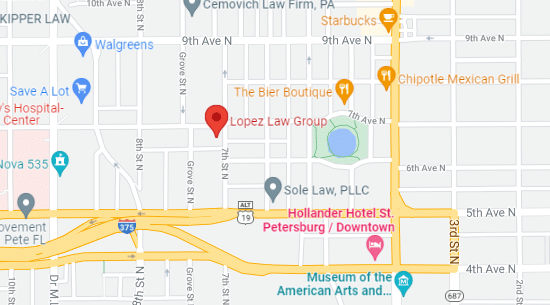
Lopez Law Group
700 7th Ave N, Suite A,
St. Petersburg, FL 33701
P: 727-933-0015
Business Hours
Mo, Tu, We, Th, Fr
Schedule a Call Back
Book a Consultation